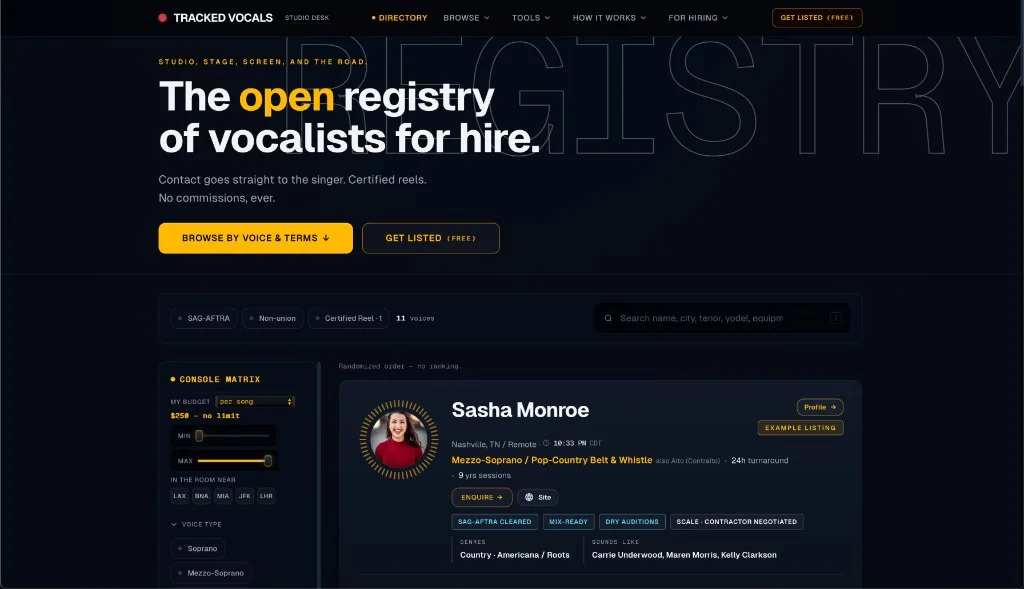
This did not start with a strategy session. It started with me scrolling Instagram.
A video comes up: a session singer I've worked with for years, at a studio in Nashville. The producer next to her is venting about how hard it's gotten to find session singers. You dig through hashtags. You cross-reference SoundBetter. You hope. And for the serious projects — the ones that need union singers, real credits, real reliability — there's no single place you actually trust.
I've lived both sides of that problem for years. So something in me went: that's not a complaint. That's a spec.
The step almost everyone skips
I didn't open a code editor. I didn't write a prompt that starts with "build me."
I took the idea to Meta AI — the AI attached to the exact platform where the complaining was happening — and asked: is this a pattern? Is this pain abundant inside Instagram and Facebook, or did I just watch one frustrated producer?
Abundant. Here's the shape of it. Here's what people keep saying in comments.
That's a demand check that cost nothing and took minutes. Idea from the wild, verified in the wild, before a dollar of compute got spent. If you take one move from this story, take that one.
Into the machine
From there it entered the company.
Some context: I run my businesses on a 31-seat AI organization — 34 role playbooks, models from ten different labs, structured like an actual company with executives, departments, and gates. Publications, courses, software. What follows is one build moving through it.
Gemini did the market research: the competitive landscape, why the existing options are resented, where the gap is. Claude Fable did strategy: what this thing had to be, who it served, and what it had to refuse to become. The answer looked like an Airbnb-style directory for vetted session singers — union talent included — built for someone casting a serious record, not another gig-economy bazaar.
Then the build pair. Opus architected and directed: structure, sequencing, what gets built in what order. Grok executed at volume, at a fraction of the cost. Expensive model decides, efficient model types.
There was a ton of back and forth between those two. This was not one prompt and a miracle. My job inside the loop: press the buttons only a human can press, follow the architect's instructions, and make the call whenever a decision had taste or risk in it.
Where it stopped being a toy
The moment a database existed, the stakes changed. A talent directory stores people's information — and in this industry, that includes parents managing profiles for minors. That is not a move-fast zone. That's a get-it-right-or-don't-ship zone.
Opus kept a running security tab through the entire build. Fable closed the loop on how the data would be handled. And then I did the paranoid thing my company's doctrine is built on: I brought in a model from a completely different lab — GLM — gave it no loyalty to the work, and told it to try to break the site.
Adversarial review, cross-lab, on purpose. It's the same rule my Auditor seat runs on: the lab that built the thing never gets to be the one that clears it.
I won't list what we hardened, and I won't claim the site is unbreakable — saying that in public is an invitation, and real security is ongoing, human-involved work. What I'll claim is simpler: it was attacked before it was ever shown to anyone.
Day four
On day four, I put the site in front of the singer from the video that started all of this.
Her read: it looks amazing, the idea is right, and it's too much. Too much information hitting you at once. Make it digestible, screen by screen.
She was right, and it forced the best product decision of the build: mobile gets the minimal layout, desktop gets the full expanded view. Because the expanded view is the product — the density of detail is exactly what a producer casting a record needs, and exactly what a phone can't carry.